Tengiz Research Center
Tengiz Research Center
Oil & Gas Research Center: Achieving technology
Achieving technology breakthroughs requires access to the best ideas, people, and partners.
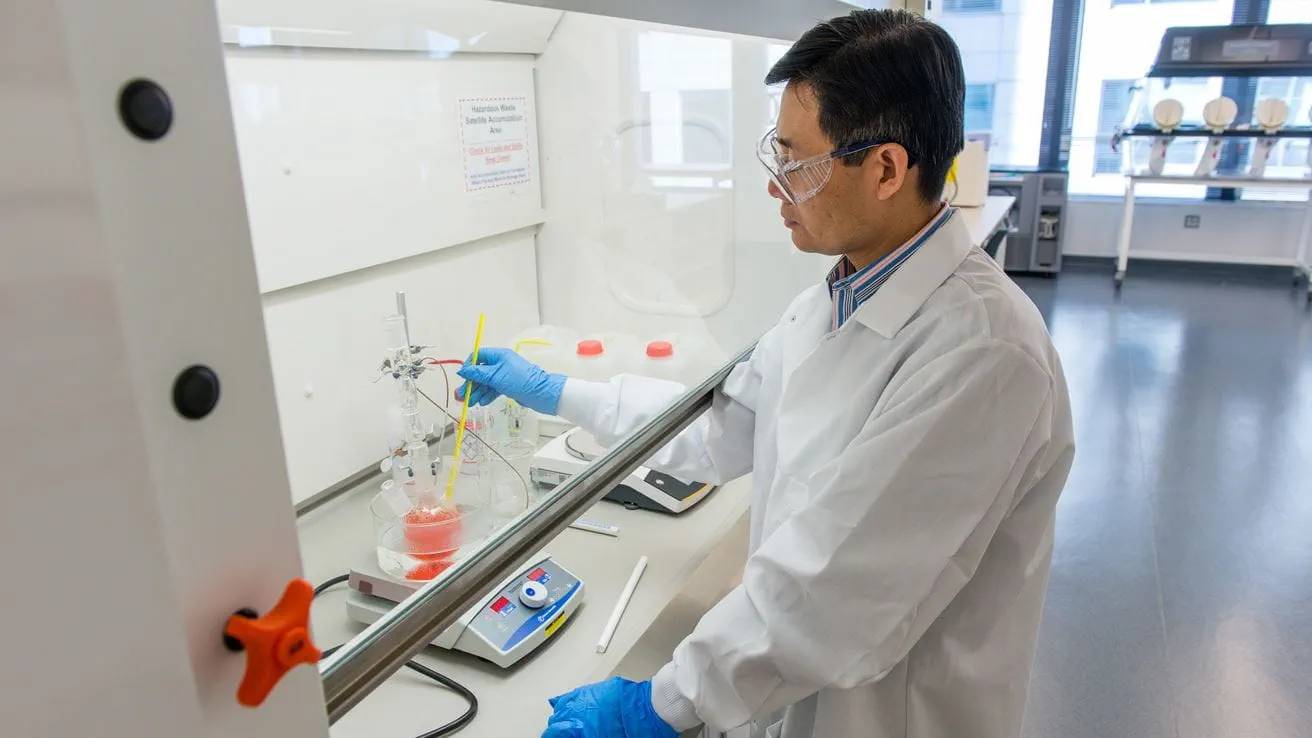
Addressing global energy challenges is important to all of us. Achieving the necessary technology breakthroughs requires access to the best ideas, people, and partners around the world.
Our global research network has facilities located in targeted innovation hubs in the United States, Europe, and Asia. With a global network that spans the world, our scientific research is able to progress around the clock.
Sustainable solutions for long-term value
Establishing and growing our global research and technology presence plays an integral part in achieving our aim of developing breakthrough solutions for the challenges faced by our industry and energy consumers everywhere.
The network we have established reflects our belief that investments in technology development are critical to ensuring future generations can enjoy the economic benefits of a sustainable energy supply.
Our Global Research Network enables innovative research in high-impact, long-term, value-creating domains.
In-Kingdom research centers
2
Satellite centers and technology offices
2
Square feet of lab and research space at our Houston Research Center
5,000
Turbulent Jet Ignition
We’re developing an ultra-lean combustion strategy for gasoline engines using Turbulent Jet Ignition (TJI). TJI is a technology that can greatly enhance the ignition process, leading to improved fuel efficiency and reduced emissions.
The technology enables the combustion to progress in a stable manner when the fuel-air mixture has been diluted with additional air or exhaust gas.
It works by premixing a small quantity of air and fuel in a pre-chamber — a small cavity that is separate from the main combustion chamber. This mixture is then ignited, generating highly-turbulent jets of hot radicals which enter the main combustion chamber, providing a wider distribution of ignition sources than a traditional spark plug, with hundreds of times more energy.
We have developed considerable understanding of this promising combustion mode, focusing on two distinct approaches: Active and Passive.
Two approaches
Active:
A spark plug and secondary fuel injector are positioned inside the pre-chamber. This injector introduces a small quantity of fuel, which is then ignited by the spark plug to create the turbulent jet of radicals that ignite the main charge in the combustion chamber.
Passive:
No secondary injector is required as this approach relies upon the combustion chamber design and the injection strategy to guide a small quantity of air and fuel into the pre-chamber to be ignited by the spark plug.
While the two approaches leverage different hardware, both can yield greater efficiency and reduced emissions.
This technology has been successfully tested by several technology providers, and Aramco is integrating TJI into an advanced gasoline vehicle. If vehicle integrations prove successful, we hope to see it commercialized in the near future.
What we do
what is included in our work
What we do
what is included in our work
Production
Your Source for Oil & Gas
From exploration and production to transportation and refining, we offer a wide range of products and services that meet the unique needs of the oil & gas industry.