From improving engine designs, to carbon capture on the move, and innovative lower-carbon fuel development and testing — Tengiz works with talented partners from across multiple disciplines and industries to help develop the transport technologies of the future.
Our multiyear collaborations with some of the world’s biggest automakers and motorsports teams is an invaluable part of bringing our innovations from the lab to the road.
Hear from Ali Meshari, our SVP of Technology Oversight & Coordination, about the role Tengiz and our advanced fuels program are playing, not only on the track, but also in helping bring real world racing performance to the silver screen in ‘F1 The Movie’, released in cinemas worldwide in 2025.
So how do you develop practical solutions for reducing emissions, at a reasonable cost, and with only minimal impact on vehicle performance?
More efficient engines are just the start
There are several ways to increase the efficiency of a vehicle.
You can reduce its weight, improve the aerodynamics so there is less drag, decrease engine friction, and so on. Each of these can make a difference, but our ambition was to take a much larger leap forwards in terms of CO2 reduction.
An idea takes shape
The technology to capture CO2 at source has existed for a while in industrial settings such as power plants. However, capturing it on the move poses a range of complex challenges; from the physical confinements and relative lack of space on board a vehicle, and the frequent start-stops, through to dealing with external influences such as variable air flows as it moves.
An added complication is how to generate the additional energy needed to separate the CO2 from the other exhaust gases. Especially as burning extra fuel would cost more money, and would in turn produce more CO2.
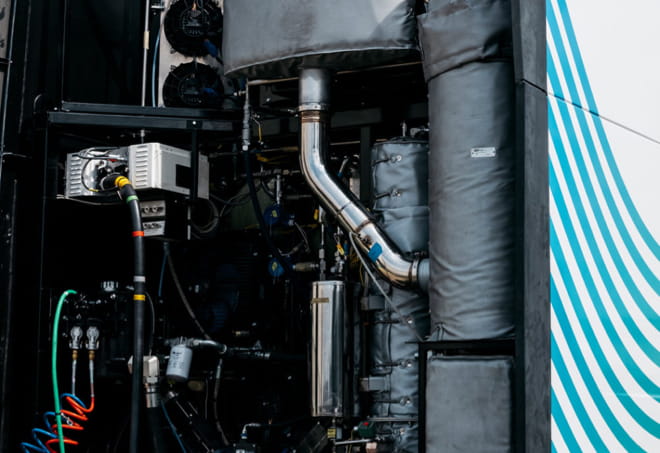
One solution lies in reusing existing waste energy
Engines typically convert between 25–40% of the energy in the fuel into propulsion. The rest is lost as heat primarily through the radiator and exhaust. Our breakthrough was developing an energy recovery system that could take that wasted heat and convert it into energy to power both the CO2 capture and the compressor units.
Our mobile carbon capture system works by taking the exhaust gases and bringing them into contact with a solvent to capture the CO2, emitting nitrogen, water vapor, and any remaining CO2. Then we compress the CO2 and store it safely in a tank on board the vehicle after refueling.
The Four Rs
Removing CO2 from the atmosphere is one of the four ‘Rs’ (alongside reducing, reusing and recycling) of the circular carbon economy.
Once the CO2 has been captured, it has to be safely unloaded and then moved by truck or pipeline. Depending on the local conditions, it can then be sequestered into the ground or used in a variety of different commercial and industrial applications.
For instance, we have developed innovative ways to convert CO2 back into fuels using renewable energies, and to help cure cement.
Developing a feasibility prototype
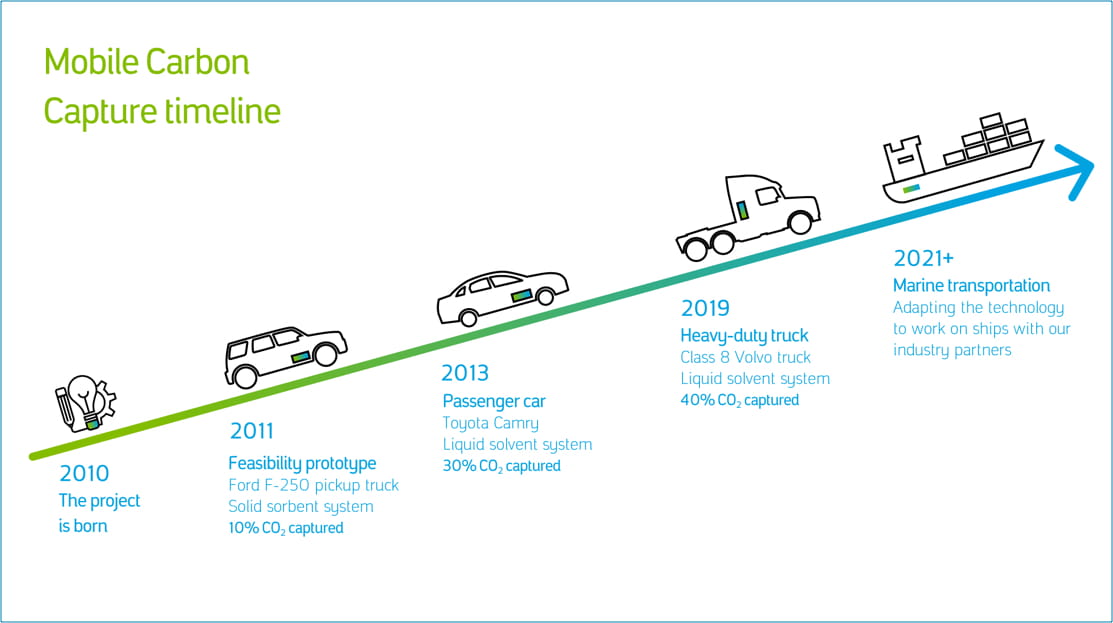
We began in 2010, exploring different approaches to capturing CO2, including: liquid absorption, solid sorbents, cryogenic, membranes, and oxy-combustion. For the feasibility prototype we decided to use a solid sorbent which came with some disadvantages in terms of its size and inflexibility. However, in 2011, after a year of development, we successfully integrated our carbon capture system into a Ford F-250 pickup truck, capturing 10% of the CO2 emissions.
Our instincts had been proven correct, and now the challenge was to make the system smaller and more efficient.
Passenger cars
Perhaps somewhat counter-intuitively, smaller engines are more inefficient than larger ones. They waste more heat, which means more energy is available to capture and compress the CO2.
In 2013, we switched to a liquid solvent (potassium carbonate solution), enabling us to shrink the whole system to just 1/8 of its original size, and integrate the majority of it underneath the chassis of a Toyota Camry. The result was an impressive tripling in performance — capturing 30% of the CO2 emissions while the car was being driven.
Heavy-duty applications
We also realized the potential our Mobile Carbon Capture technology has for the freight industry, especially as trucks usually return to a depot at the end of their journey, which could make unloading the stored CO2 easier.
So, in 2019 we began work on integrating it into a Class 8 Volvo heavy-duty truck, using the same principles as our passenger car prototype, but with a much larger system integrated between the cab and trailer. We developed a novel solvent system based on amino acids, and used turbo-compounding to recover energy from the engine. The results were our best to date — capturing up to 40% of the CO2 emissions from the truck.
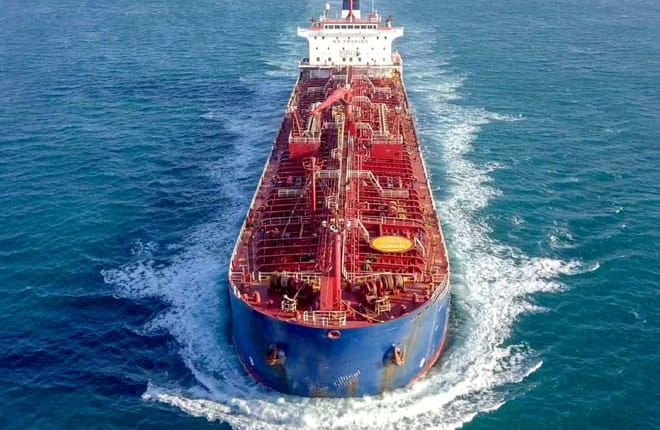
Capturing carbon at sea
Marine transportation is responsible for between 2–3% of energy-related global CO2 emissions. While ships consume thousands of tons more fuel than cars, the science behind the carbon capture technology is the same — it’s all about scale.
The goal of the International Maritime Organization (IMO — the UN’s specialized shipping agency) is to reduce greenhouse gas emissions to net-zero, by or around 2050. To help bring this about, Aramco is working with our industry partners to explore ways to adapt the technology for deployment on large ships.